
Completion of the Research Project adjust
Background and project goals
Urban districts play a key role in achieving national climate targets and the goal of greenhouse gas neutrality by 2045. At the same time, municipalities and project stakeholders face complex challenges: competing objectives, a wide range of involved actors, and a lack of integrated planning and decision-support tools continue to hinder the implementation of sustainable energy and mobility concepts at the district level.
Against this backdrop, the research project adjust has been successfully completed. The project aimed to develop a scientifically sound and practice-oriented tool for the forward-looking, multi-criteria planning and assessment of post-fossil energy and mobility systems in urban districts. adjust was part of the Applied Excellence Department of the Ruhr University Alliance (https://applied-excellence.de/) and followed a transdisciplinary approach with a strong focus on practical application.
Results
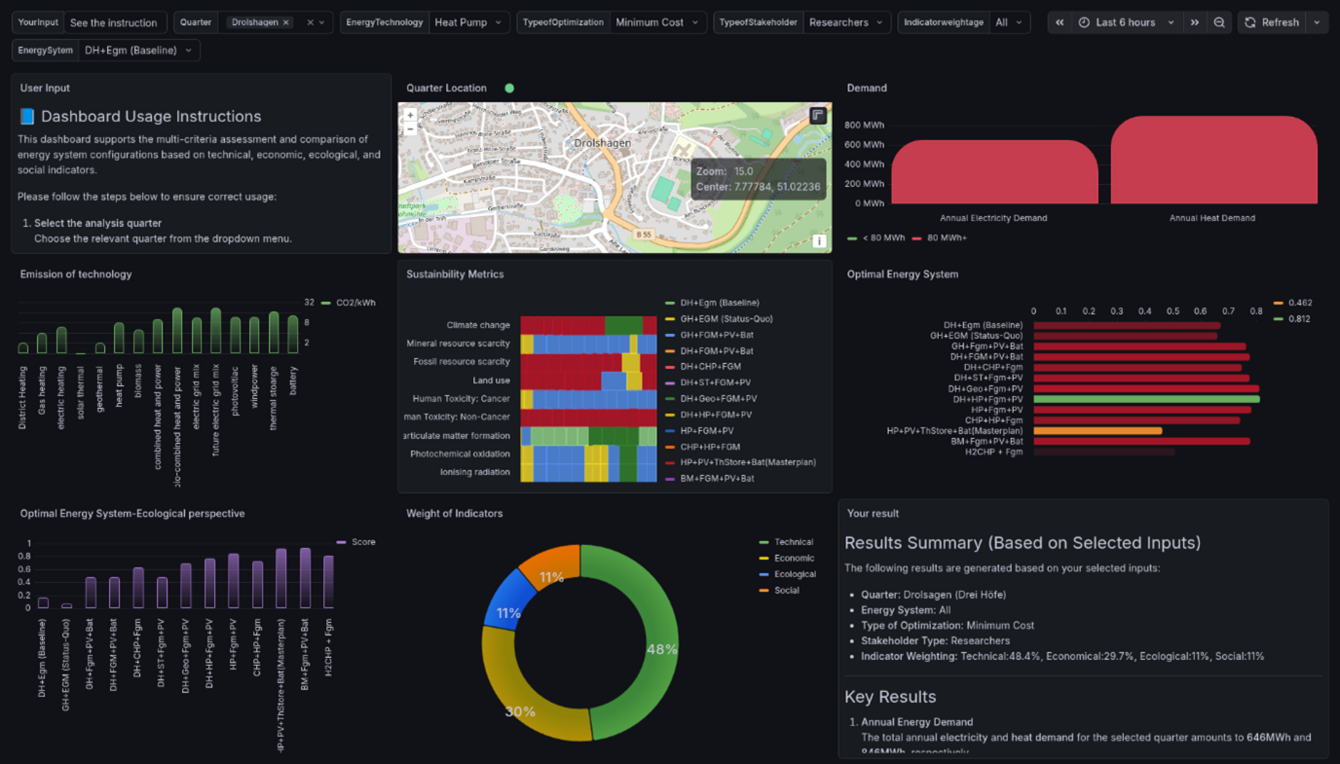
Within the project, established methods such as energy system modeling (ESM), life cycle assessment (LCA), scenario analysis, and multi-criteria decision analysis (MCDA) were combined for the first time within an integrated planning framework. This made it possible to systematically link technical, environmental, economic, and social objectives and to transparently identify trade-offs between them. The methodological development was accompanied by continuous exchange with relevant stakeholders to ensure practical relevance and transferability. The approaches were tested using the planned district “Drei Höfe” in Drolshagen as a case study, but are fundamentally transferable to other urban districts. Both established and emerging energy and mobility technologies were considered, including innovative energy generation and storage solutions. Key outcomes of the project include consistent future scenarios, optimized energy system designs, and a robust, integrated sustainability assessment of alternative district-level energy system solutions. The core result of the project is the concept of an adaptive decision-support dashboard, which translates complex scientific results into an accessible and actionable format for different user groups. In order to develop a user-oriented design, online workshops were conducted with stakeholders from Drolshagen. The dashboard was implemented as a mock-up and demonstrates how planning options, sustainability impacts, and scenarios can be clearly visualized and compared.
Overall, adjust demonstrates that integrated, multi-criteria planning approaches can make a significant contribution to the sustainable transformation of urban districts. The developed methods and the dashboard concept provide a solid foundation for future research and implementation projects in the context of the urban energy transition. The project results have already been presented at international conferences and were or will be published in peer-reviewed scientific journals or conference proceedings (e.g. https://www.vde-verlag.de/buecher/566633/neis-2025.html).
Screenshot of the developed dashboard mock-up for comparing alternative district energy system options.
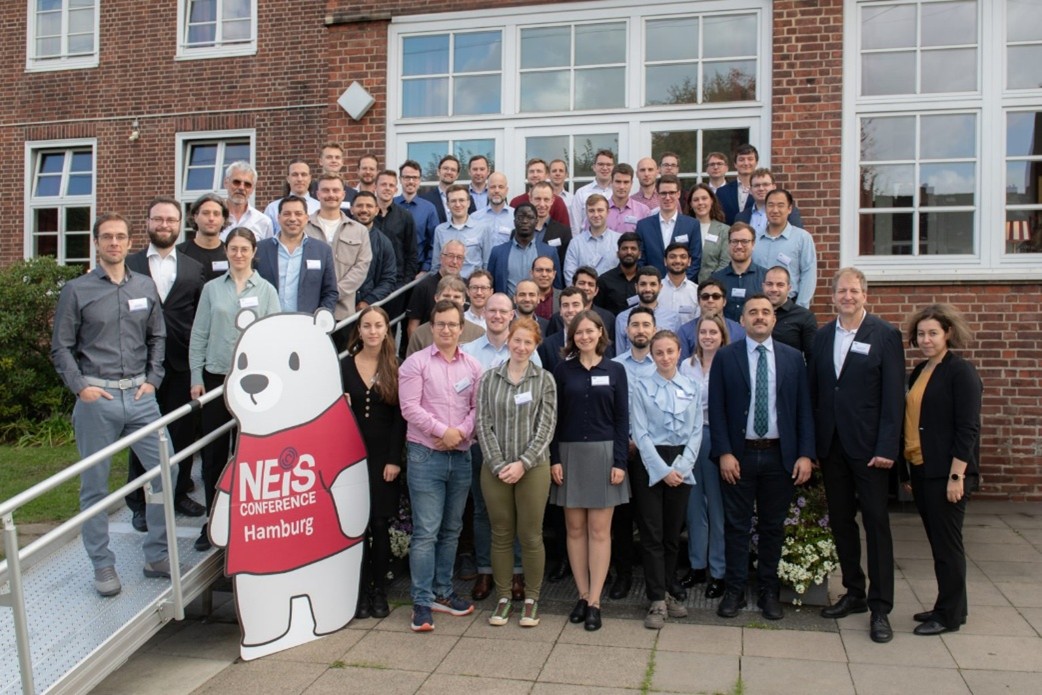
Participation in the NEIS Conference 2025 in Hamburg, including the presentation of project results titled “Life Cycle Assessment of a Flow Battery as Stationary Storage for a Renewable-Based Energy District”.