
The Sustainable Technologies Laboratory won two Awards at the Second International Conference on Sustainable Energy Education, SEED
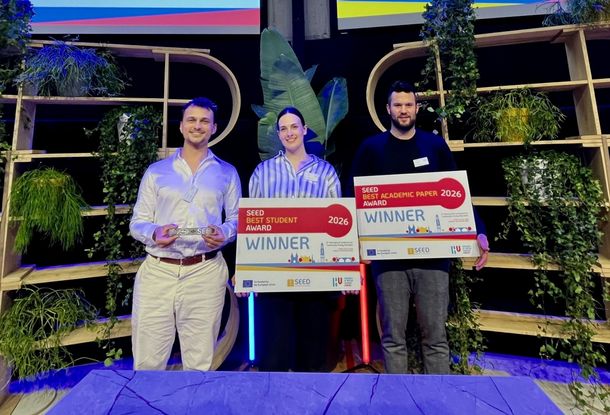
The nominees from the Sustainable Technologies Laboratory won two awards: the "SEED Best Academic Paper Award 2026" for the work of Dr. E. A. Recklies, S. Eduardo, and S. Severengiz, and the "SEED Best Student Award 2026" for the work of Laura Semrau and Eric Faulhammer.
The Second International Conference on Sustainable Energy Education (SEED 2026) took place in Utrecht from March 24th to 25th, 2026. It brought together researchers, educators, industry professionals, and policymakers to discuss innovative approaches, best practices, and strategies for advancing sustainable energy education. Read more about the conference and the laboratory’s contributions.
The conference program included oral presentations of academic papers and expert articles, as well as posters from students and professionals. On the second day of the conference, March 25, the scientific jury presented awards in four categories: “SEED Best Academic Paper Award”, “SEED Best Expert Article Award”, “SEED Best Poster Award”, and “SEED Best Student Award”.
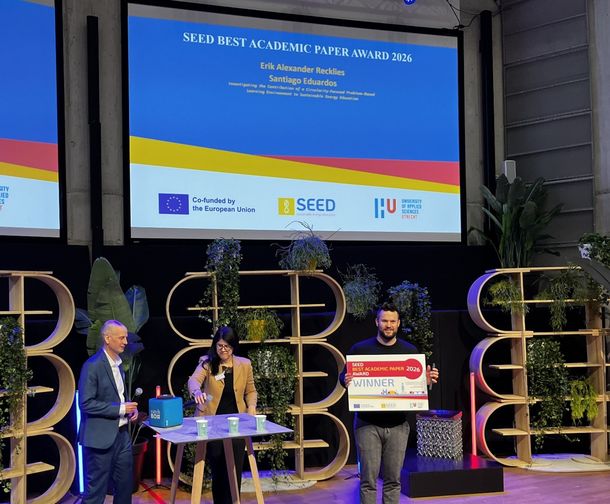
We are delighted to announce that the academic paper "Investigating the Contribution of a Circularity-Focused Problem-Based Learning Environment to Sustainable Energy Education," co-authored by Dr. Erik A. Recklies, Santiago Eduardo, and Semih Severengiz, won the "SEED Best Academic Paper Award 2026" (Fig.2).
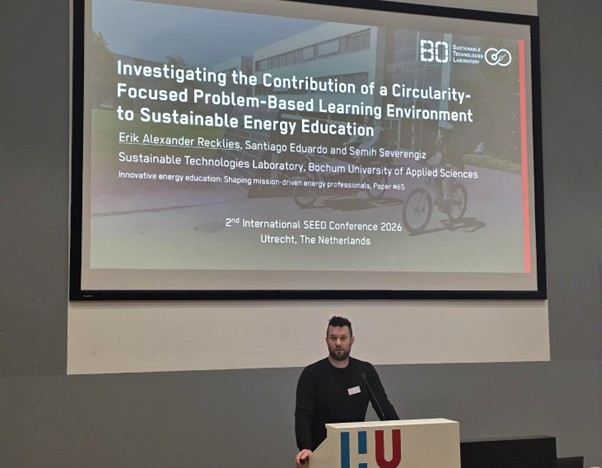
This paper, presented at the Conference by Dr. Erik A. Recklies (Fig.3) stems from the CIRCLE project, which provides a novel problem-based learning environment that integrates circular design principles into sustainability courses at the university level. The paper illustrates how CIRCLE can contribute to sustainable energy education. Using the example of a proton exchange membrane fuel cell, the paper details the extent to which participating students assess and enhance product circularity while acquiring theoretical knowledge of key facts, central concepts, and relevant energy-related technologies, as well as practical competencies.
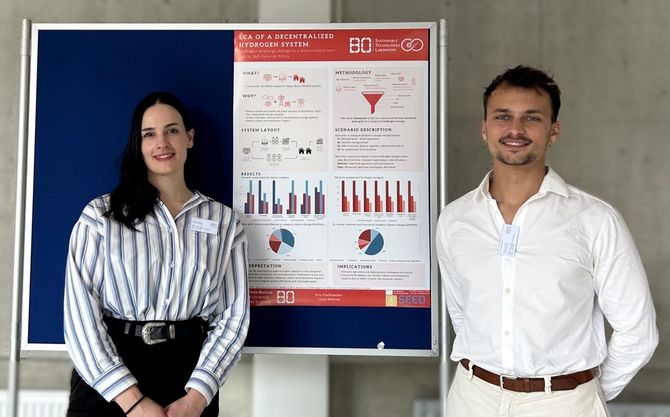
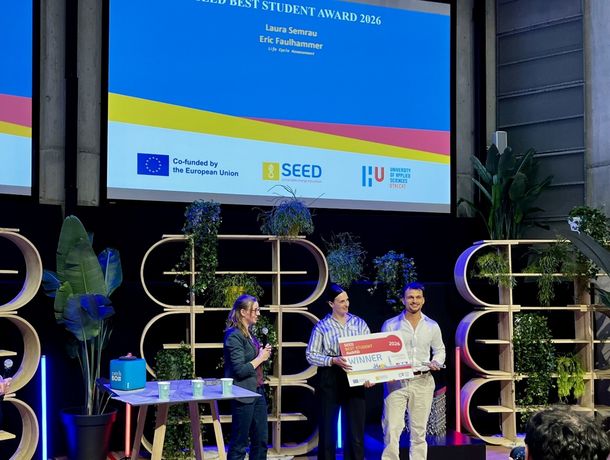
We are also delighted to announce that the project poster titled "LCA of a Decentralized Hydrogen System," presented by Laura Semrau and Eric Faulhammer, won the "SEED Best Student Award 2026" (Fig.4). Laura and Eric developed this project within the Sustainable Energy Impact project seminar. It demonstrates the background, methodology, and results of the life-cycle assessment of a hydrogen energy storage system in a decentralized mini-grid in Sub-Saharan Africa (Fig.5).
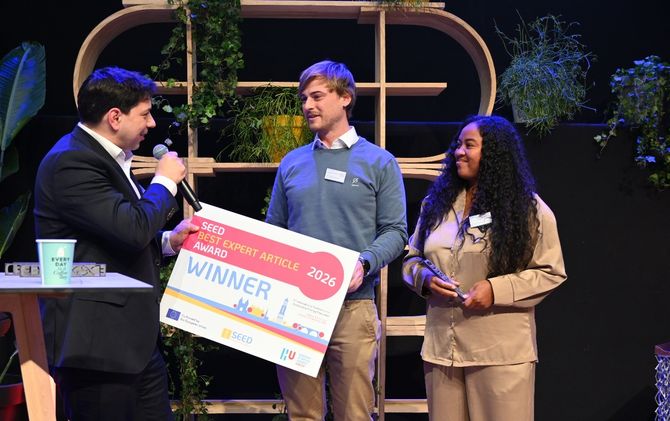
Prof. Dr.-Ing. Semih Severengiz had the honor of announcing the “SEED Best Expert Article Award 2026” for “Cooking up Learning: Clean-Cooking Education and Global Collaboration between Germany and Madagascar," which was co-authored by Julian Spratte, Santatriniaina Josiah Andriamahazoarilala, and Franziska Schaube (Fig.6). The collaboration between the University of Applied Sciences Düsseldorf and the University of Antananarivo exemplifies how practical educational approaches and local engagement can promote the adoption of clean cooking methods and foster international knowledge exchange, aligning with the Sustainable Development Goals.
These and other academic papers and expert articles of the 2nd SEED Conference 2026 are available at https://seedconference2026.eu/proceedings/.
At the conclusion of the closing ceremony, Prof. Dr.-Ing. Semih Severengiz announced the Third International Conference on Sustainable Energy Education (SEED 2028), which will be held in Bochum in 2028 (Fig.7).
Congratulations to all the award winners, and we look forward to the next SEED conference!