

Advanced Nursing Practice
As an Advanced Practice Nurse (APN), you will take on challenging tasks in the direct care of patients, advise relatives and support nursing teams in complex clinical and care situations. You will coordinate treatment processes and implement evidence-based measures. In addition, you may work in nursing consultancy, quality and project management, or the further development of nursing concepts.
At a glance
- Degree:
- Master of Science
- Standard period of study:
- 6 semesters
- Programme start:
- Winter semester
- Campus:
- Health Campus Bochum
- Instruction language:
- German
- Credit points:
- 120 credit points
- Type of programme:
- Part-time studies
- Type of admission (NC):
- Open admission (no NC)
- Notice:
- Applications from the winter semester 2027/28* (subject to accreditation)
The master's degree programme in Advanced Nursing Practice is aimed at nursing professionals who want more: more responsibility, more scope for initiative and more influence over patient care. This programme is not just about practising nursing – it’s about actively developing the profession.
During the programme, you will combine academic thinking with practical experience and learn to manage complex care situations independently and make evidence-based decisions. In doing so, you will grow into a role that has long been established in an international context: that of the Advanced Practice Nurse – a key position at the interface between Nursing, medicine and research.
This degree programme is ideal for you if you are already working in the Nursing profession and wish to take your expertise to the next level. If you are ready to take on responsibility, work in an interdisciplinary manner and play an active role in shaping the future of Nursing, you will find exactly the right environment here.
Course content
Clinical Nursing Practice
Advanced Practice Nurses are regarded as key figures in managing complex care scenarios. To fulfil this role, students are taught a comprehensive range of skills that enable them to confidently apply case analysis and diagnosis to people with multidimensional problems. This is covered, amongst other things, in the modules ‘Clinical Assessment and Pharmacology’ and ‘People in Highly Complex and Critical Life Situations’.
Advanced Nursing and Practical Competences
This module area focuses on the role of nursing professionals with advanced clinical expertise, as well as the legal framework. Furthermore, competences are developed in the areas of interprofessional collaboration, guidance, counselling and case management, clinical-ethical decision-making, as well as coaching and clinical leadership, in order to strengthen professional practice in complex care situations.
Scientific Work and Research Methods
Advanced Practice Nurses are not only involved in direct patient care but also play an active role in shaping the future development of nursing. They participate in research projects, develop evidence-based nursing standards and contribute to quality assurance in the health care sector. Central to this is the ability to apply scientific findings in a targeted manner to practice and to improve care in the long term. To this end, the programme imparts sound research skills as well as knowledge and skills in translational research. In your final master`s thesis, you will have the opportunity to apply these skills independently and to undertake a scientific study on a topic relevant to practice.
Study days
Study days during the semester are limited to two days per week and combine face-to-face and online teaching. One study day takes place online every two weeks, whilst you spend two days on campus every 14 days.
Elective area
During your degree, you will have the opportunity to specialise through an elective area, thereby developing your professional skills in a targeted manner. In doing so, you will deepen your knowledge in particularly relevant and future-oriented areas of care, which are becoming increasingly important due to demographic developments and the growing complexity of the health care system:
- Acute and Critical Care Nursing for anyone wishing to take on responsibility in acute and intensive care settings. Particular emphasis is placed on the management and coordination of complex treatment processes, the implementation of evidence-based Nursing interventions and the optimisation of the quality of care.
- Community Health Nursing for those who wish to play an active role in shaping health promotion and Nursing care outside the hospital setting. The aim is to ensure needs-based care outside acute inpatient settings, to promote health equity and to support vulnerable population groups.
Practical Experience
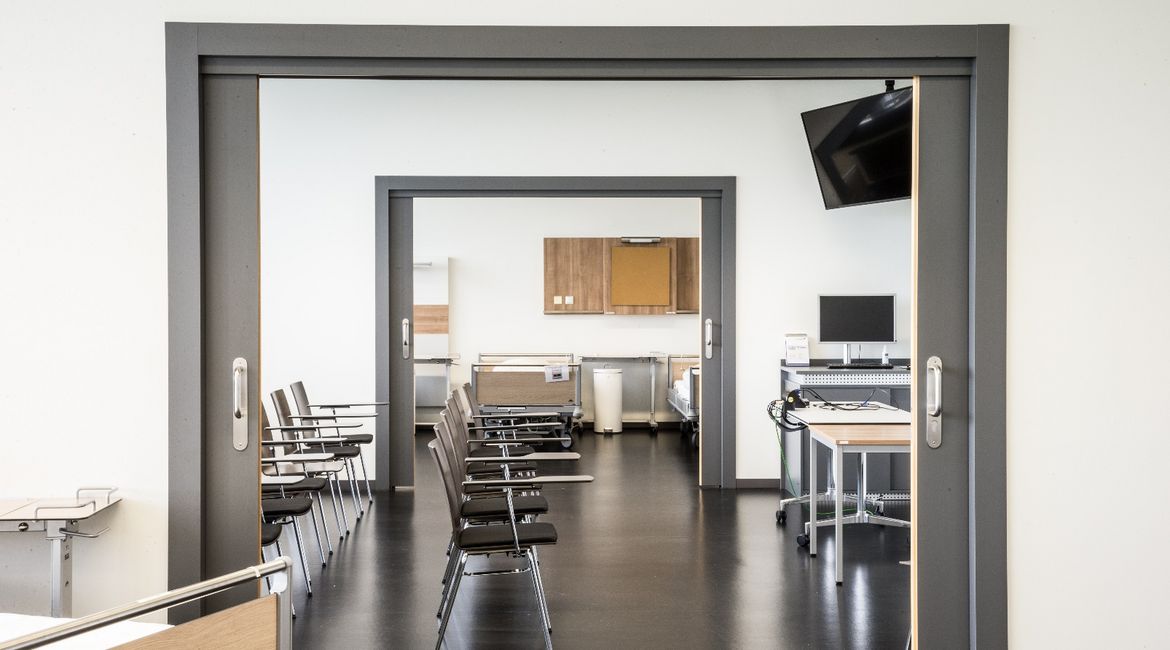
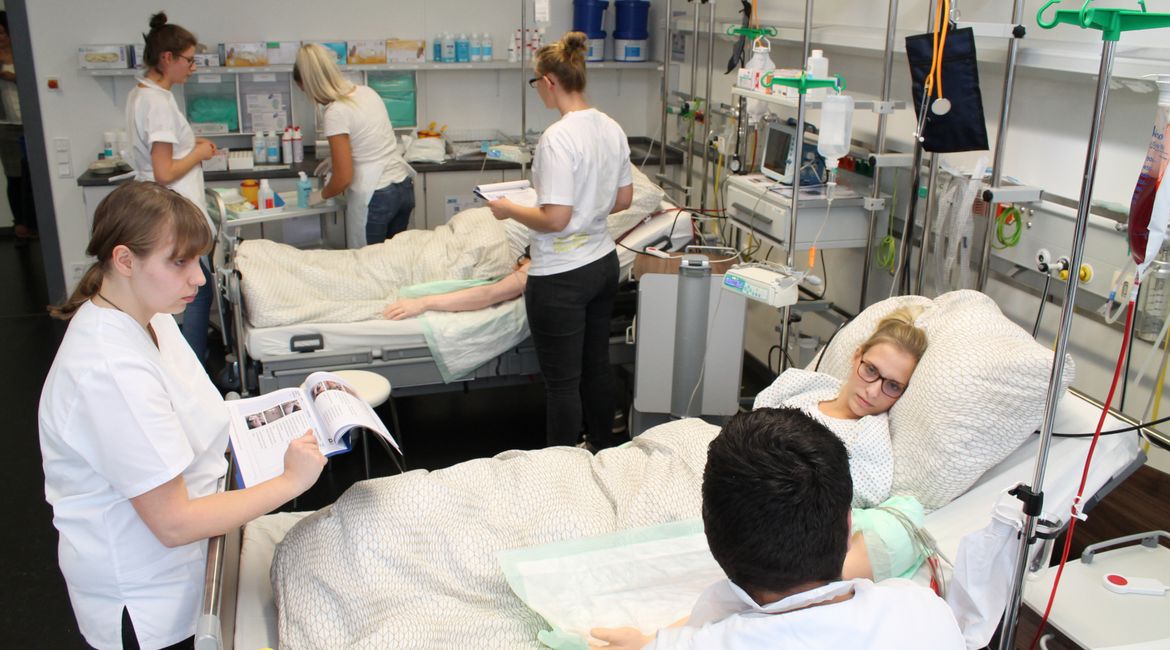
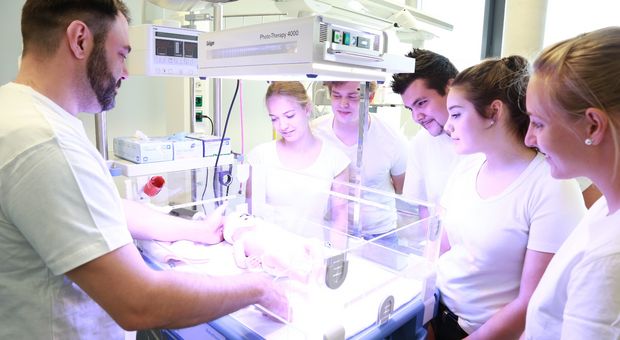
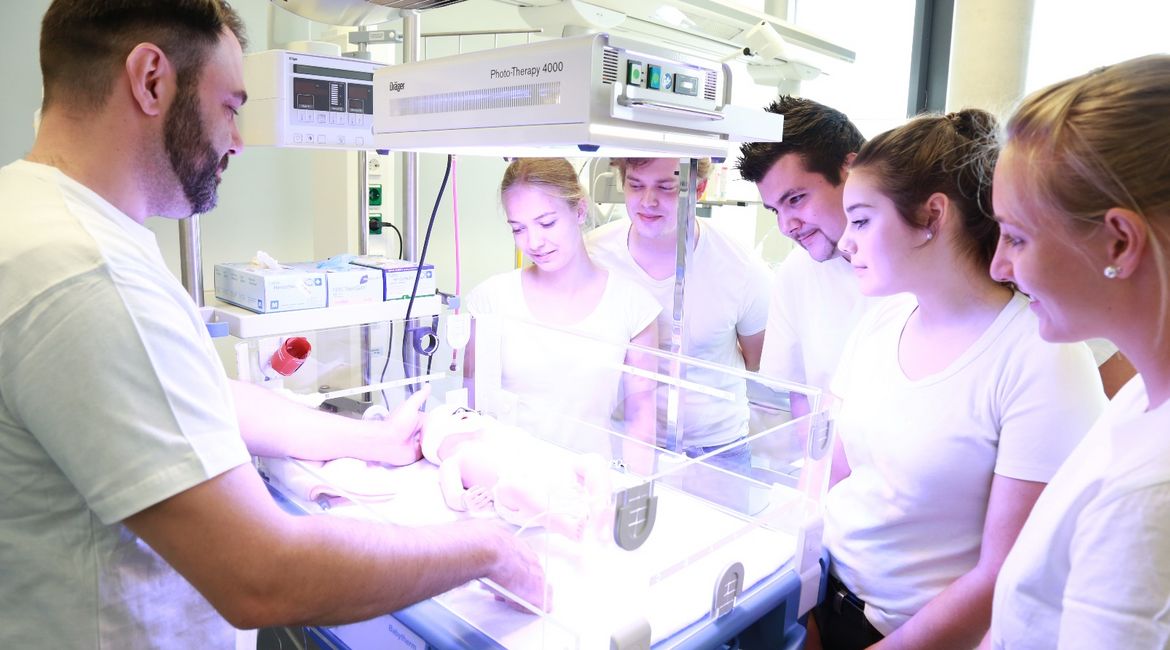
The degree programme is characterised by a continuous focus on practical application and offers you the opportunity to work part-time in a clinical setting alongside your studies – something that is expressly encouraged. In the department’s skills labs, you can also expect numerous practical exercises where you can practise nursing techniques and concepts under realistic conditions. In this way, you combine theory and practice right from the start and develop the confidence to implement the requirements of advanced Nursing practice competently and confidently. The fifth semester also includes a comprehensive practical module, during which you will have the opportunity to shadow experienced nurses and advanced practice nurses in their day-to-day clinical work.
Study Abroad
In the final semester, you have the opportunity to undertake a study abroad placement and thus gain international experience in a nursing context. This gives you the chance to undertake a placement in countries such as the USA, Canada, Switzerland or the Netherlands, where the role of Advanced Practice Nurses is already firmly established. Gaining an insight into other healthcare systems opens up new perspectives on advanced nursing practice and enables you to expand your professional profile in a targeted manner and benefit from international best practices.
Certificate
You will also receive the ‘Nursing Adviser’ certificate. You will acquire all the necessary skills in the ‘Guidance, Counselling and Case Management’ module, which is based on the recommendations of the GKV-Spitzenverband regarding the required number, qualifications and continuing professional development of nursing advisers.
Completed initial vocational training
Applicants must be able to provide evidence of having successfully completed initial vocational training (in addition to the degree described below). This must have been undertaken in one of the following occupational fields:
- Registered Nurse
- Paediatric and Child Health Nurse
- Health and Medical Nurse
- Geriatric Nurse
Completed degree
Admission to the Advanced Nursing Practice (ANP) master's degree programme is generally possible if a relevant first professional university degree has been obtained beforehand.
The degree must be nursing-related and may, for example, have been obtained in one of the following degree programmes:
- Nursing
- Nursing Science
- Nursing Management
- Nursing Education
Other forms of evidence may be accepted
The specialist focus of the first professionally qualifying university degree may, in exceptional cases, also be demonstrated by other documents. These include
- particularly outstanding achievements in professional practice following the first professionally qualifying university degree,
- particularly outstanding achievements in the second half of the first professionally qualifying university degree programme, or
- a thesis of outstanding quality and particularly relevant to the nursing and health care sector from the first professionally qualifying university degree programme.
Important:
The necessary assessments are made by the examination board following the submission of suitable documentation during the application and enrolment process – where necessary, a personal interview may also take place.
German language skills
For applicants who did not obtain their university entrance qualification in Germany or at a German school abroad, proof of sufficient German language skills is required as a further admission requirement. This applies also to German citizens.
Qualification objectives and potential career paths
As an Advanced Practice Nurse (APN), you will take on challenging tasks in direct patient care, advise relatives and support nursing teams in complex care situations. You will coordinate treatment processes and implement evidence-based measures. In addition, you may work in nursing consultancy, quality and project management, or the further development of nursing concepts.
Subject-specific student advice


The fast-track option on the ANP degree programme: Is it an option for you?
The Fast-Track is an optional study pathway within the master's degree programme in Advanced Nursing Practice, which will be offered from the 2028/29 winter semester/fall semester onwards.
It offers you the opportunity to shorten the standard period of study to four semesters and complete your degree more quickly.




This option is particularly suitable for students who are highly self-organised, resilient and self-motivated. If you are able to prioritise your studies clearly and remain focused even during intensive periods, the fast-track programme can be an attractive alternative to the standard course of study.
However, you should be aware that shortening the duration of your studies also involves a significant intensification of the course content. In the first two semesters, the number of days of face-to-face teaching increases from two to three days a week. At the same time, both the required independent study time and the number of module final examinations to be taken per semester double. Overall, the time commitment is therefore equivalent to that of an intensive degree programme.
Against this background, you should carefully consider to what extent it is realistic to work at the same time.
We particularly recommend the standard part-time programme for students who have not yet been able to gain any practical work experience following their first professional higher education qualification. This offers more scope to effectively combine your studies with your professional development.
The fast-track programme is particularly suitable for those who opt for an intensive, compact study phase and wish to progress swiftly towards their academic qualification. Ideally, you will already have at least two years’ professional experience, so that you can better contextualise the theoretical content of the programme, link it to your practical experience and reflect on it. With this option, you should focus clearly on your studies and only undertake part-time work to a very limited extent.
Do you ideally possess the following qualities?
- A high degree of self-organisation, resilience and motivation
- The ability to concentrate and work in a focused manner, particularly when under a heavy workload
- At least two years’ professional experience
Can you realistically factor in the high intensity of the Fast-Track programme?
- More time spent on campus and a significantly greater learning workload (comparable to an intensive degree programme)
Does the Fast-Track programme fit in with your current life situation?
- Work commitments? Family responsibilities? Leisure plans?
Would you like a personal consultation?
We’d be happy to provide you with a personalised assessment and advice via email or during our online consultation hours.
The Master’s degree programme in Advanced Nursing Practice will be offered from the 2027/28 winter semester onwards, subject to successful accreditation.


