

Sustainable Technologies Laboratory at the GCSM in Colombo
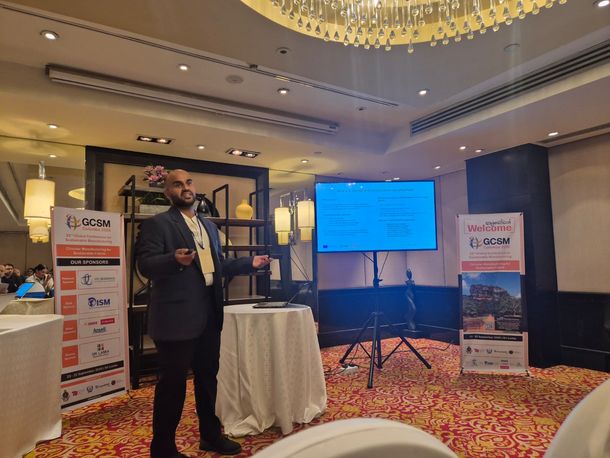
From September 23 to 25, 2026, the Laboratory for Sustainability in Engineering (LNT) at Bochum University of Applied Sciences participated in the 22nd Global Conference on Sustainable Manufacturing (GCSM) in Colombo, Sri Lanka. The international conference brings together researchers and experts from various countries and provides a platform for professional exchange and international networking in the field of sustainable technologies and production.
The LNT was represented by Prof. Dr. Semih Severengiz, Surya Kumar Deravajan, Eric Faulhammer, and Laura Semrau. With two presentations, the team showcased current work from the GH2GH and H2VE projects.
As part of the GH2GH project, the paper “Life Cycle Assessment of a Hydrogen-Integrated Mini-Grid: A Scenario Comparison” was presented. Using a life cycle assessment, the paper examines the environmental impacts of a hydrogen-integrated mini-grid system and compares various development scenarios. The presentation was given by Eric Faulhammer and Laura Semrau.
In addition, the H2VE project was presented with the paper “Advancing Vocational Excellence in Hydrogen Education: A European Framework and Guide for Networkers.” Surya Kumar Deravajan presented the results of the project, which focuses on the further development of vocational education in the field of hydrogen as well as the European networking of education and innovation stakeholders.
With over 140 presentations by international researchers, the GCSM offered a wide range of insights into current research. Each of the three conference days began with two keynote speeches. Cultural events, such as the opening ceremony featuring live drummers and dancers, as well as a group dinner at the Lotus Tower, rounded out the conference.
The international exchange with researchers and other participants provided exciting ideas, new perspectives, and networking opportunities.
The GCSM was organized by Holger Kohl, Günther Seliger, Franz Dietrich, Fazleena Badurdeen, JR Gamage, and Asela Kulatunga and took place in cooperation with the Technical University of Berlin, the Fraunhofer IPK, and the University of Moratuwa.


