

Levels of Research
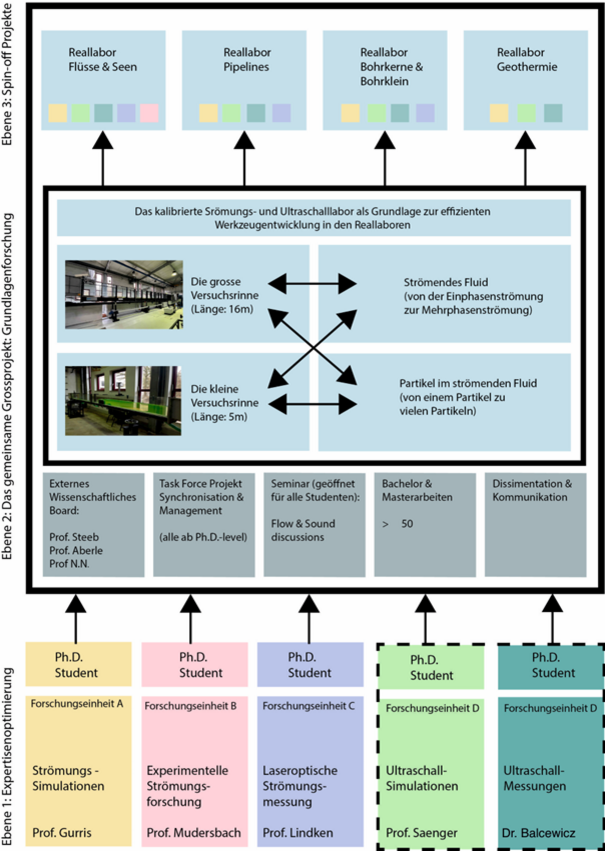
Level 1: Expertise Enhancement
At the first level, the individual research groups within the participating chairs deepen and expand their core competencies in flow simulation, ultrasound simulation, experimental fluid dynamics, laser-optical flow measurement, and ultrasound-based measurement techniques. Initially, these research activities are conducted independently, with the primary objective of systematically generating and consolidating the knowledge base required for the subsequent two research levels.
Level 2: Fundamental Research – Joint Large-Scale Research Project
Within the framework of the fundamental research activities, a jointly operated, calibrated flow and ultrasound laboratory will be established, accompanied by the development of digital twins of the experimental facilities. This research infrastructure will provide the foundation for the transdisciplinary integration of the tools and methodologies employed by all participating research units and will serve as the basis for the real-world laboratories (Research Level 3). The primary objective of this interdisciplinary collaboration is to harmonize, validate, and optimize the applied techniques and methodologies. Under highly controlled laboratory conditions, the facility will enable the investigation of innovative concepts across a wide range of flow scenarios, as well as the development, testing, and optimization of novel ultrasound-based flow measurement techniques.
To this end, two existing flumes of different sizes (lengths of 5 m and 16 m) will be utilized (Research Unit: Prof. Mudersbach). By introducing selected particulate materials into the flow, a variety of well-defined flow scenarios can be generated under precisely controlled experimental conditions. These scenarios will be investigated using complementary flow measurement techniques developed and applied by the research units of Prof. Lindken, Prof. Mudersbach, and Dr. Balcewicz. Each experimental campaign will be accompanied by corresponding digital twins, incorporating computational fluid dynamics (CFD) simulations (Research Unit: Prof. Gurris) and ultrasound wave propagation simulations (Research Unit: Prof. Saenger). The close integration of numerical modeling and experimental investigations will enable rigorous calibration, validation, and continuous refinement of the applied methodologies.
Level 3: Spin-off Projects
Building on the scientific findings obtained, these are applied to specific problems in various application-oriented projects (spin-off real-world laboratories). These include, among other things, flow studies in water bodies (rivers and lakes), ultrasound-based measurement methods for material transport in pipelines, the characterization of flow signatures in drill cores and cuttings, and the monitoring of flow processes in geothermal reservoirs. The resulting momentum fosters the development of new research approaches and industry partnerships and lays the foundation for further application-oriented projects. In other words: a research initiative is being launched at Bochum University of Applied Sciences. With the KÖNIG research project, the project consortium aims to play a role at the forefront of international research and make a sustainable contribution to cutting-edge international research.


