

Research Units
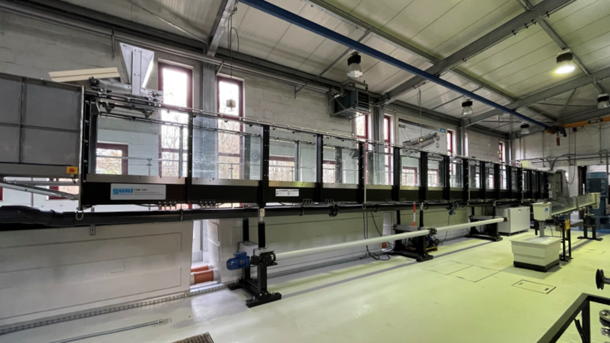
The project is thematically structured into four research units.
Research Unit A, led by Prof. Dr. rer. nat. Marcel Gurris, focuses on the numerical simulation of fluid flows. The research comprises the simulation of incompressible single-phase and multiphase flow fields, which provide the boundary conditions for subsequent simulations of ultrasound wave propagation. Particular emphasis is placed on capturing flow phenomena across multiple spatial scales, ranging from small-scale flow domains to flow fields representative of natural rivers.
Research Unit B, headed by Prof. Dr.-Ing. Christoph Mudersbach is dedicated to experimental fluid dynamics. The Chair of Hydraulic Engineering and Hydrodynamics at Hochschule Bochum hosts the project's central experimental facility: a 16 m long flume funded by the German Research Foundation (DFG). The research objectives are (a) to improve flow velocity and discharge measurements in natural flows under conditions of simultaneous sediment transport and (b) to enhance the accuracy of sediment transport measurements.
In addition to conventional fluid dynamics investigations, the flume also enables the application of high-precision laser-optical measurement techniques. These activities are carried out within Research Unit C, led by Prof. Dr.-Ing. Ralph Lindken. Within the project, the laser-optical measurements serve as a reference for validating the results obtained with the newly developed measurement techniques, as they represent one of the most accurate measurement methods currently available for this type of application.
Research Unit D, directed by Prof. Dr. rer. nat. Erik H. Saenger, comprises two main research areas. The first focuses on the numerical simulation and experimental investigation of ultrasound wave propagation in flowing media. The objective is to develop acoustic measurement techniques for determining flow velocities and, in the long term, for characterizing multiphase flows in both open and closed systems. The experimental research is conducted under the leadership of Dr. rer. nat. Martin Balcewicz.
For the experimental investigations, a multi-channel ultrasound measurement system with up to 38 channels is available, supporting both time-of-flight and Doppler ultrasound measurement techniques. Its flexible channel architecture allows the number and arrangement of sensors to be configured according to the specific measurement task and experimental geometry, enabling highly adaptable measurement setups.
The numerical research focuses on high-performance simulations of ultrasound wave propagation under flowing conditions. Together with computational fluid dynamics simulations, these models provide virtual representations of the physical experiments, thereby establishing an efficient digital laboratory for the systematic optimization of ultrasound-based measurement techniques. Two key scientific challenges are addressed: the integration of moving fluids into existing wave propagation algorithms and the further development of Time-Reverse Imaging (TRI)for the localization of particles in liquids and gases.


