

GITI Consortium at Halfway Mark
The project “Green IT Impact: Resource-efficient software development for sustainable IT solutions” (GITI) aims to develop an innovative service and business model that supports reliable life cycle assessments (LCA) of software products as part of quality assurance in software development. For developers and stakeholders, such assessments are a basic prerequisite for reducing the resource consumption of software and working towards certification.
To achieve this, the project identifies metrics, methods, and tools by transferring current research results into practice, simplifying ecological sustainability testing and making it applicable in everyday development. To assess the economic and ecological opportunities and risks, the approach will be applied to software products, with and without integrated AI functionalities, as part of a proof of concept (PoC), and then evaluated and optimized further.
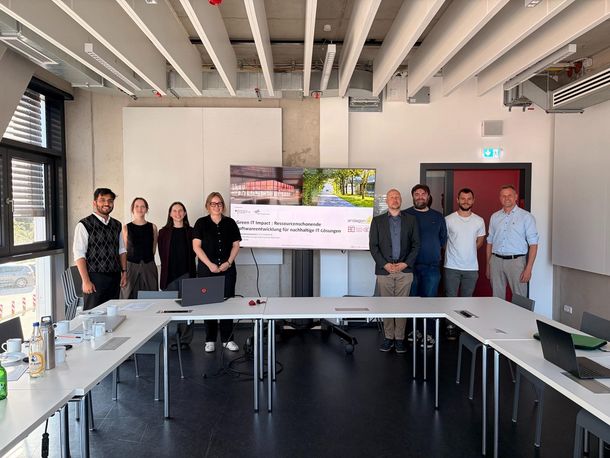
On 5 October 2026, the project consortium met at Bochum University of Applied Sciences to discuss the interim findings. The meeting was hosted by the Sustainable Technologies Laboratory (STL), led by Prof. Dr.-Ing. Semih Severengiz. Topics included current practice regarding the tools and metrics available for software measurement, as well as customers’ requirements for adopting sustainable software testing. STL presented first figures from the life cycle assessment of a chatbot tutor. According to this, hardware is the main driver, contributing approx. 70% to the GWP. In the baseline scenario of the chatbot tutor, this amounts to approx. 60.4 kg CO₂-eq./year. In addition, the partner company andagon introduced its draft of a consulting concept for green software testing.
With these findings in place, the project now enters the first proof of concept (PoC), focusing on software without AI functionalities, which will be followed by an evaluation together with the relevant partners. The consortium also discussed current challenges and how to incorporate feedback from the project sponsor. We sincerely thank the Federal Ministry of Research, Technology and Space (BMFTR) for its valuable input and feedback.
The GITI project is funded by the German Federal Ministry of Research, Technology and Space (BMFTR) under the funding line KMU-innovativ, grant numbers 01LY2408A/B. We thank the BMFTR for funding the project and DLR Projektträger for its support.


