

Hannover Messe 2026: Impressions from the World's Largest Industrial Trade Fair
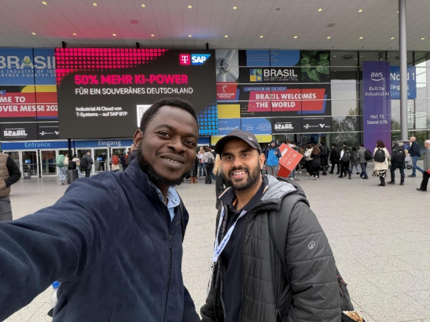
Members of the Sustainable Technologies Laboratory of Bochum University of Applied Sciences attended Hannover Messe 2026 on 23 and 24 April in Hannover. This year's edition ran under the theme "Think Tech Forward" and brought together industry, research institutions, and policymakers from across Europe and beyond. Brazil was the Partner Country, with a strong presence particularly in the hydrogen discussions, given the country's renewable energy base and growing relevance as a potential green hydrogen exporter under the EU-Mercosur framework.
The visit focused on the Energy and Industrial Infrastructure area, combining conference sessions and time on the exhibition floor. A consistent theme across both days was the link between sustainability and digital traceability. Topics such as the Digital Product Passport, battery lifecycle data, green hydrogen certification, and interoperable production standards all pointed to the same need: reliable digital information flowing across the value chain. Digital twins in particular appeared across nearly every field, from energy systems and battery management to product development and manufacturing, reflecting how central they have become to modern industrial practice. The EU Battery Regulation and the legislation on the Digital Product Passport already make this a concrete requirement for industry and research.
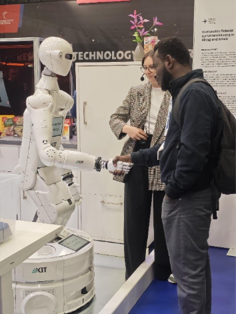
On the hydrogen side, the conversations have clearly moved on. The focus is no longer on whether the technology works, but on how to make it cost-effective, certifiable, and viable at scale. Sessions on green hydrogen certification, AI-driven plant optimization, and advancements in fuel cell technologies gave a realistic picture of where the field stands today and what the next steps look like.
Battery circularity was equally visible. Cylib, an RWTH Aachen spin-off, stood out as a strong example of how EU-funded research can scale toward industrial application, recovering critical raw materials from spent lithium-ion batteries with high efficiency. Their facility at CHEMPARK Dormagen in NRW, due to be operational in 2027, is one of the clearest signs that battery recycling in Europe is moving from pilot scale to industrial reality.
The fair also highlighted Latin America as a growing area for green hydrogen collaboration, with Brazil's renewable energy base and active project pipeline drawing significant attention and opening up concrete opportunities for international partnerships. The visit provided useful connections with research institutions and companies working in hydrogen, fuel cells, battery circularity, and decentralized energy systems, and helped identify directions worth pursuing in future research and project development.


