

Successful thesis on the planning of energy systems in neighborhoods
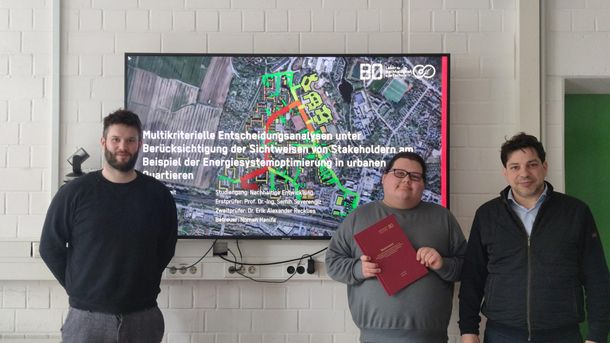
On May 13, 2026, Lion Rudi presented his master’s thesis as part of the colloquium at the Laboratory for Sustainability in Technology. The thesis was supervised by Prof. Dr. Semih Severengiz (head of the laboratory) and Dr. Erik Alexander Recklies (research associate). Lion Rudi completed the Master’s degree program in Sustainable Development at Bochum University of Applied Sciences and had already worked as a student research assistant in the laboratory during his studies.
His master’s thesis, entitled “Multi-Criteria Decision Analyses Considering Stakeholder Perspectives Using the Example of Energy System Optimization in Urban Districts,” investigated how the subjective perspectives of different stakeholders (NGOs, companies, and research institutions) influence the weighting of criteria and the outcomes of decision analyses. The thesis builds on the completed research project “adjust” conducted by the Laboratory for Sustainability in Technology.
The results reveal both commonalities and lines of conflict between the stakeholder groups surveyed. The study shows that, on the one hand, there is awareness of the relevance of technical and economic evaluation criteria, while on the other hand, ecological and social criteria are prioritized differently by stakeholders. Multi-criteria decision analyses can be used to evaluate a wide range of possible supply solutions with regard to these priorities. Energy system simulations and life-cycle assessments enable the aggregation of the necessary data for this purpose. On this basis, the most sustainable solution can be selected. This supply solution can then serve as a target vision for further steps in the energy transition within urban districts.
Several conclusions can be drawn for the planning of energy systems: Although the stakeholder groups show clear differences regarding their preferred supply solutions, individual technological components remain controversial. All groups, however, show a preference for shallow geothermal energy and reject the use of hydrogen in building energy supply. Combined heat and power generation using biogas was also discussed as part of the analysis.
Overall, the thesis demonstrates tools that can support planning processes for the energy transition. Their concrete integration into participatory formats offers further opportunities for future research.


