

- Applied Electronics
- Applied Computer Science
- Automation Engineering
- Autonomous Systems
- Business Informatics
- Controls and Automotive Systems
- Construction and CAE
- Electronics and Signal Processing
- Embedded Systems
- Engineering Mechanics & Construction
- Radio & Network Engineering
- Physics and Materials
- Software Engineering

Embedded Systems
Welcome to the Embedded Systems Research Group. The group is part of the Department of Electrical Engineering and Computer Science and is located on the Velbert/Heiligenhaus campus.
Given the highly interdisciplinary focus of the campus, the interface between hardware and software plays a central role. This research group operates precisely in this key boundary area.
Lehre
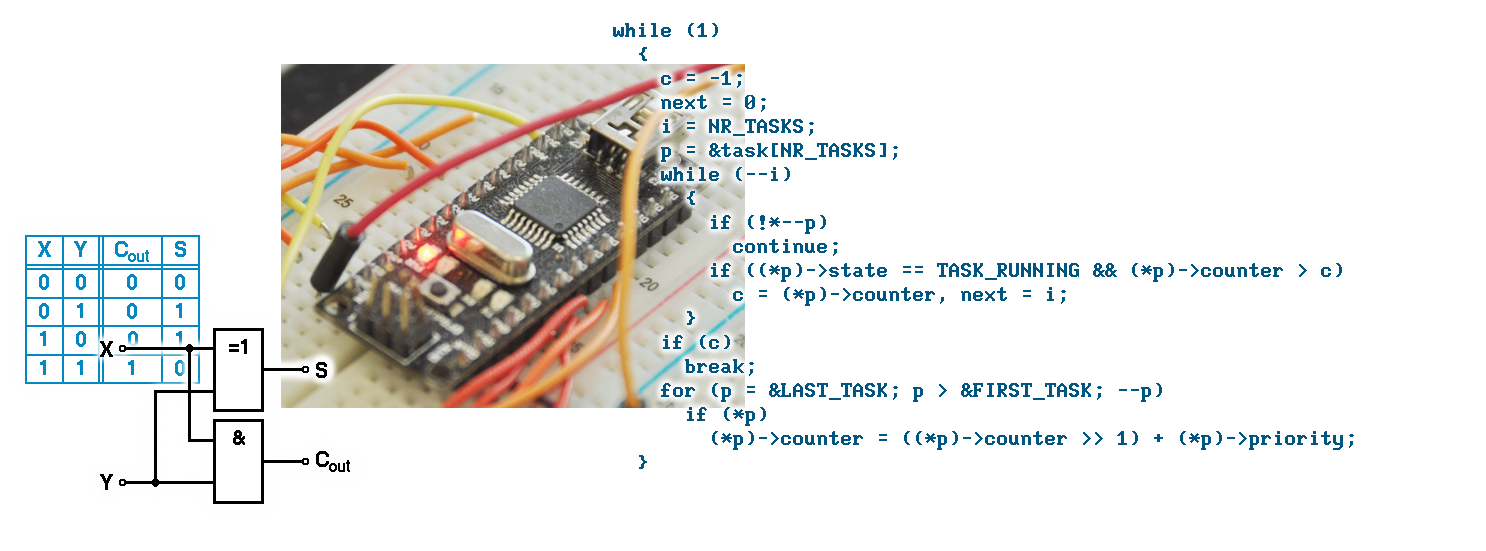
- Databases and IT-Security (Teaching materials)
- Computer engineering (Teaching materials)
- Low-level programming (Teaching materials)
- Embedded Systems (Teaching materials)
- Algorithms und data structures in C/C++ (Teaching materials)
- Driver development, real-time processing and operating systems (Teaching materials)
- Sustainable information technology (Teaching materials)

In our advanced-level courses, examinations are usually conducted in the form of a project, the topic of which you are free to choose within the scope of the respective subject.
In the context of our current research projects (see below), interesting sub-topics frequently arise that are suitable for student projects, ranging from small-scale projects to Bachelor’s and Master’s theses.
Another interesting area of research is the control of a hexapod – from inverse kinematics to autonomous operation.
If you are interested, please get in touch with us.
Useful links for preparing your documentation:
Forschung
Anleitungen für Online-Werkzeuge, die wir am CVH für die Lehre einsetzen:
- für Studierende
- für Lehrende
- in Arbeit: für die IT-Abteilung
Online-Werkzeuge, die wir empfehlen können:
- mumble für Audio-Konferenzen
- BigBlueButton und OpenMeetings als allgemeine Werkzeuge für Online-Präsentationen
- noVNC als Web-Interface für mit VNC exportierte Bildschirminhalte
- Jitsi Meet für Web-Konferenzen
- ownCloud/NextCloud für den Austausch von Dateien
- Forgejo oder GitLab als Web-Interface für Git-Repositories
… und natürlich die „klassischen“ Online-Werkzeuge: SSH, IRC, screen/tmux, ytalk usw.