
- Applied Electronics
- Applied Computer Science
- Automation Engineering
- Autonomous Systems
- Business Informatics
- Controls and Automotive Systems
- Construction and CAE
- Electronics and Signal Processing
- Embedded Systems
- Mechanics and Vehicle Dynamics
- Radio & Network Engineering
- Physics and Materials
- Software Engineering
Automation Engineering
Welcome to the Automation Technology Research Group at the Institute for Embedded Systems and Applied Computer Science. The research group is part of the Department of Electrical Engineering and Computer Science at Bochum University of Applied Sciences and is located on the Velbert/Heiligenhaus campus.
Automation, Industrial IT & Energy Management
Innovative automation technology, industrial IT, and energy management are key to the competitiveness of German industry in the coming years.
The convergence of these core technologies into an integrated solution—the cyber-physical system—is sometimes referred to as the Fourth Industrial Revolution, or “Industry 4.0” for short.
Industry 4.0
The benefits include more resource-efficient production, improved order and maintenance planning for higher availability, more flexible manufacturing and capacity utilization, better pre-production simulation, and energy-optimized production as the key to the smart grid and the energy transition.
To achieve these goals, Industry 4.0 requires breaking down the system boundaries of control engineering, IT, energy technology, production management, and maintenance through the open interfaces and communication technologies of the Internet, thereby creating an Internet of Things, or Cyber-Physical Systems.
Research & Teaching of the Working Group
The Automation Technology Working Group has set itself the goal of shaping and advancing the development of the “Industry 4.0” concept, particularly the convergence of automation and energy technology, in (application-oriented, industrial) research and teaching. In doing so, it makes a lasting contribution to securing Germany’s position as a hub for innovation and to forward-looking engineering.
Head
Prof. Dr.-Ing. Clemens Faller
Fachbereich Elektrotechnik und Informatik
Fachgebiet: Automatisierungstechnik
Raum: 1.30
Hochschule Bochum | Campus Velbert/Heiligenhaus
Kettwiger Str. 20
Prof. Dr.-Ing. Clemens Faller
Department of Electrical Engineering and Computer Science
Specialization: Automation Technology
Room: 1.30
Bochum University of Applied Sciences | Velbert/Heiligenhaus Campus
Kettwiger Str. 20
42579 Heiligenhaus
Tel.: +49 (0)2056 5848-16722
Fax: +49 (0)2056 5848-16889
Email: clemens.faller@hs-bochum.de
Areas of expertise:
- Industry 4.0
- Industrial automation and control engineering
- Industrial IT & industrial communication technology
- Energy management and energy efficiency
Office hours: by appointment
Personal website: Clemens Faller
Wissenschaftliche Mitarbeiter
Industry 4.0 and the Digitalization of Manufacturing
The key to Germany’s economic strength lies in focusing on the strength of its manufacturing industry. However, in order to remain competitive in a globalized world where competition is growing ever stronger in terms of functionality and quality, it is necessary to make production systems and processes more flexible through close (IT-based) integration of the production level with the planning level, all the way through to customers and suppliers. This enables the efficient and rapid creation of customized products, making imports from Asia no longer competitive. This IT-based integration has been known for some time as Industry 4.0, although many challenges must be overcome regarding issues such as networking, industrial IT, cyber-physical systems, and the Internet of Things. This is the focus of the working group’s research and technology transfer activities.
Energy Management and Energy Efficiency
A prerequisite for improving energy efficiency is the reliable collection of current, time-dependent consumption data for individual processes. In the future, the lab factory will be powered via a central control cabinet equipped with six networked wattmeters to record power consumption trends.
Consulting services
In addition to jointly acquiring and carrying out research projects, the working group also offers consulting services based on its expertise in the aforementioned fields. In particular, detailed potential analyses in the areas of “Industry 4.0” and “energy-efficient production” can serve as a solid foundation for subsequent grant-funded projects, helping to establish the current status in advance for the development of an action plan.
Please feel free to contact us!
Research Projects
Project WisE-Pro
Knowledge-Based Decision-Making Tools for Sustainable Production in Small and Medium-Sized Enterprises
The goal of the BMBF-funded “WisE-Pro” project under the FHprofUnt funding program is to develop and implement a comprehensive concept for knowledge-based decision-making aimed at sustainable production. For the manufacturing company, this means using energy and production data to gain an understanding of production efficiency and thereby identify opportunities for increased efficiency and, as a result, greater sustainability. They are supported in this by an energy efficiency consulting concept, which is to be offered by an energy supplier in the future. For the energy supplier, this involves generating insights into its customers’ energy consumption to make informed decisions regarding energy demand planning with a focus on the use of renewable energy. Through collaboration between energy producers and consumers, data exchange enables optimized use of available energy, thereby minimizing the need to maintain reserves from conventional energy sources.
Technical Focus of the Development Work and Current Project Status
One way to create new systems—ones that are manageable for SMEs—lies in the development of new web-based services. With cloud-based software solutions and associated business models that make the software more cost-effective for small businesses, combined with expert consulting services, SMEs can leverage the knowledge and experience of specialists while continuing to focus on their core business. The companies involved in this project see a competitive advantage in being able to optimize their production from a holistic perspective or to support their customers in this task.
This support can be provided through consulting services offered by energy suppliers. In the era of the energy transition, the Energy Services Act has made it mandatory for energy suppliers to inform their customers about energy efficiency measures. Many energy suppliers see this as an opportunity to transform themselves into energy partners. The Velbert/Heiligenhaus region is characterized by a relatively high density of small and medium-sized metalworking companies that still maintain personal contacts with their energy suppliers. Stadtwerke Velbert and Stadtwerke Heiligenhaus are interested in new business models and wish to remain long-term partners for the region’s small and medium-sized enterprises.
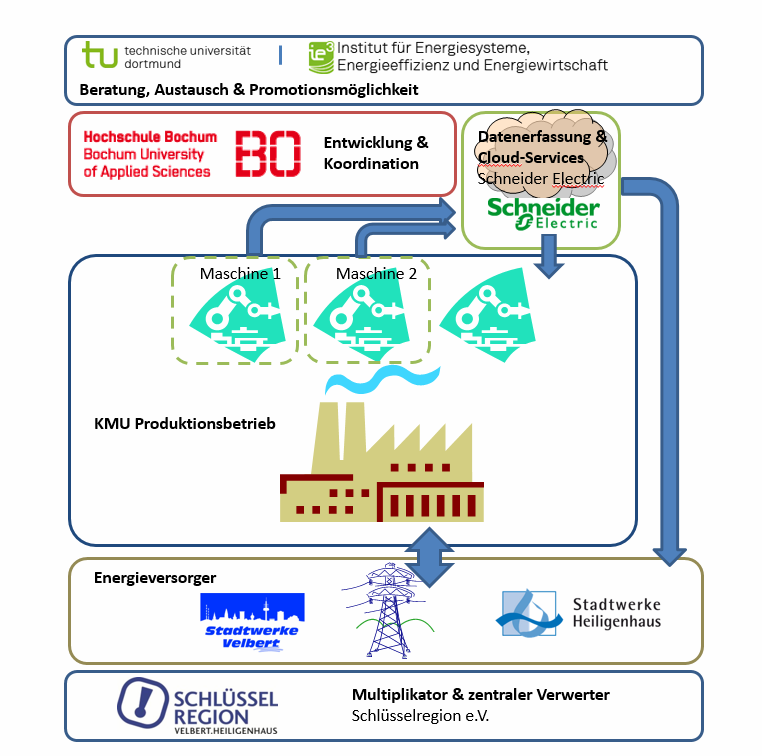
The technical core of the development work is a system for collecting energy data in combination with production data from automated facilities, which is then sent to the cloud via a cloud-edge controller for analysis. There, the data is available for use by the company, as well as by consultants who provide targeted support to SMEs in achieving savings, and—in anonymized form—by utility providers, who will use it to optimize energy planning in the future (see figure).
In an initial reference scenario, the Heiligenhaus municipal utility was connected bidirectionally to the Bochum University of Applied Sciences’ learning factory via the cloud edge controller (via Beck IPC).
This created, as an example, the interfaces to all relevant data providers (production and energy suppliers), initially with a focus on secure data transmission over the internet, as well as the testing and structure of the cloud data collection. Currently, the possibility of implementing functions to calculate relevant KPIs and evaluate them is being examined. Furthermore, the appropriate visualization methodology for different user groups and the authorization check will be developed in the coming months.
In collaboration with the municipal utilities of Velbert and Heiligenhaus, a selection of data was developed that is useful for each party (Lernfabrik/municipal utilities). The Lernfabrik made a selection of the data previously stored locally available on a server in the cloud, with the aim of being able to vary and simulate errors and energy consumption in the Lernfabrik and to gain knowledge and assessment criteria for the municipal utilities as energy service providers or directly for the participating SMEs. The primary focus in the development of the criteria and data analysis is on reusability. This includes assessing the transferability of the concept to other business sectors and other utilities, as well as examining the potential for local synergies related to energy optimization within the participating SMEs (e.g., heat sources/heat demand of locally neighboring SMEs). An important aspect for the energy service provider in optimizing and modeling control power is the collection and analysis of the potential variations in energy consumption/storage within the individual companies.
Project duration: 07/2015–07/2018
The project is funded by the BMBF and managed by the Project Management Agency Jülich.
Industry 4.0 Manufacturing System
The “Industry 4.0 Manufacturing System” is a comprehensive representation of an industrial production system—ranging from mechanical transport and handling technology to electrical equipment, including automation technology, and extending to IT-based planning, control, and monitoring of processes with a focus on productivity, quality, and (energy) efficiency.
Innovative automation technology, industrial IT, and energy management are key to the competitiveness of German industry in the coming years. The convergence of these core technologies into an integrated solution—the cyber-physical system—is sometimes referred to as the Fourth Industrial Revolution, or “Industry 4.0” for short. The benefits include more resource-efficient production, improved order and maintenance planning for higher availability, more flexible manufacturing and capacity utilization, better pre-production simulation, and energy-optimized production as the key to the smart grid and the energy transition. To achieve these goals, Industry 4.0 requires breaking down the system boundaries of control technology, IT, energy technology, production management, and maintenance through the open interfaces and communication technologies of the Internet, thereby creating an Internet of Things, or Cyber-Physical Systems.
This transformation is comparable to the shift in behavior regarding communication and information in everyday life. Thanks to ubiquitous computing systems (e.g., smartphones or tablet computers), people can now communicate via various media, with different sub-functions (e.g., navigation, camera, internet access) merging to create cross-system value. This integration—vertically across the levels of the automation pyramid or horizontally with other disciplines (e.g., energy technology) and even within the supply chain—enables holistically optimized production and thus helps secure Germany’s position as a manufacturing hub.
- The “Industry 4.0 Manufacturing System” enables the exploration of all necessary research areas within this field:
A key area of research is the integration of data from different systems and seamless communication from the sensor-actuator level through the control level up to the supervisory or management level. Here, industry-ready interfaces must be developed and defined based on modern communication standards. An important area of research here is upgrading hardware components to enable them to become participants in the so-called Internet of Things. However, transparent interfaces between IT systems—especially when these span multiple disciplines (energy, production, management)—are not sufficiently defined today.
2. Sustainability and Energy Efficiency
In recent decades, automation technology has been used to make production more competitive by reducing the workforce. Today, energy prices have caught up with or even surpassed labor costs. As a result, the key to competitiveness today lies in sustainable production that takes all resource considerations into account. In particular, improving energy efficiency in industry is essential for achieving Germany’s national goal of the energy transition. Furthermore, the energy transition also requires flexible production that makes optimal use of volatile renewable energy sources. This is a central research focus for which the facility is equipped with measurement and software technology.
3. Changing Work Environment in Industry
The initial visions of fully IT-integrated production in the 1980s—then known as CIM (Computer-Integrated Manufacturing)—aimed for a production environment that was virtually devoid of human workers. Today’s Industry 4.0 approach aims to create new collaborative forms of work organization focused on qualitative enrichment, meaningful work contexts, increased personal responsibility, and self-development. These forms must be developed alongside systems that account for users’ longer working lives and provide them with support tailored to their needs.
The project was funded by the state of North Rhine-Westphalia.
Thermal Energy Recovery from Waste Heat Using Smart Materials

Sponsored by:
Courses offered as part of the bachelor’s degree program at the Velbert-Heiligenhaus campus:
- Betriebsorganisation & Produktionsmanagement
- Digitale Methoden zum kollaborativen Arbeiten und Präsentieren
- Grundlagen und Vertiefung der Automatisierung
Produktmanagement & Vermarktung
Courses offered as part of the master’s degree program at the Velbert-Heiligenhaus campus:
- IT-Systeme in Produktion und Automatisierungstechnik
Interested in academic research?
We supervise KIS, bachelor’s, and master’s theses by arrangement. If you have any topic suggestions in the fields of automation technology, industrial IT, or energy efficiency and energy management, please feel free to contact us.
Laboratory Manager