

Bringing innovative capabilities to robots and vehicles
30.04.2026 Magazin
The English-language master's degree programme in Mechatronics focuses on autonomous systems.
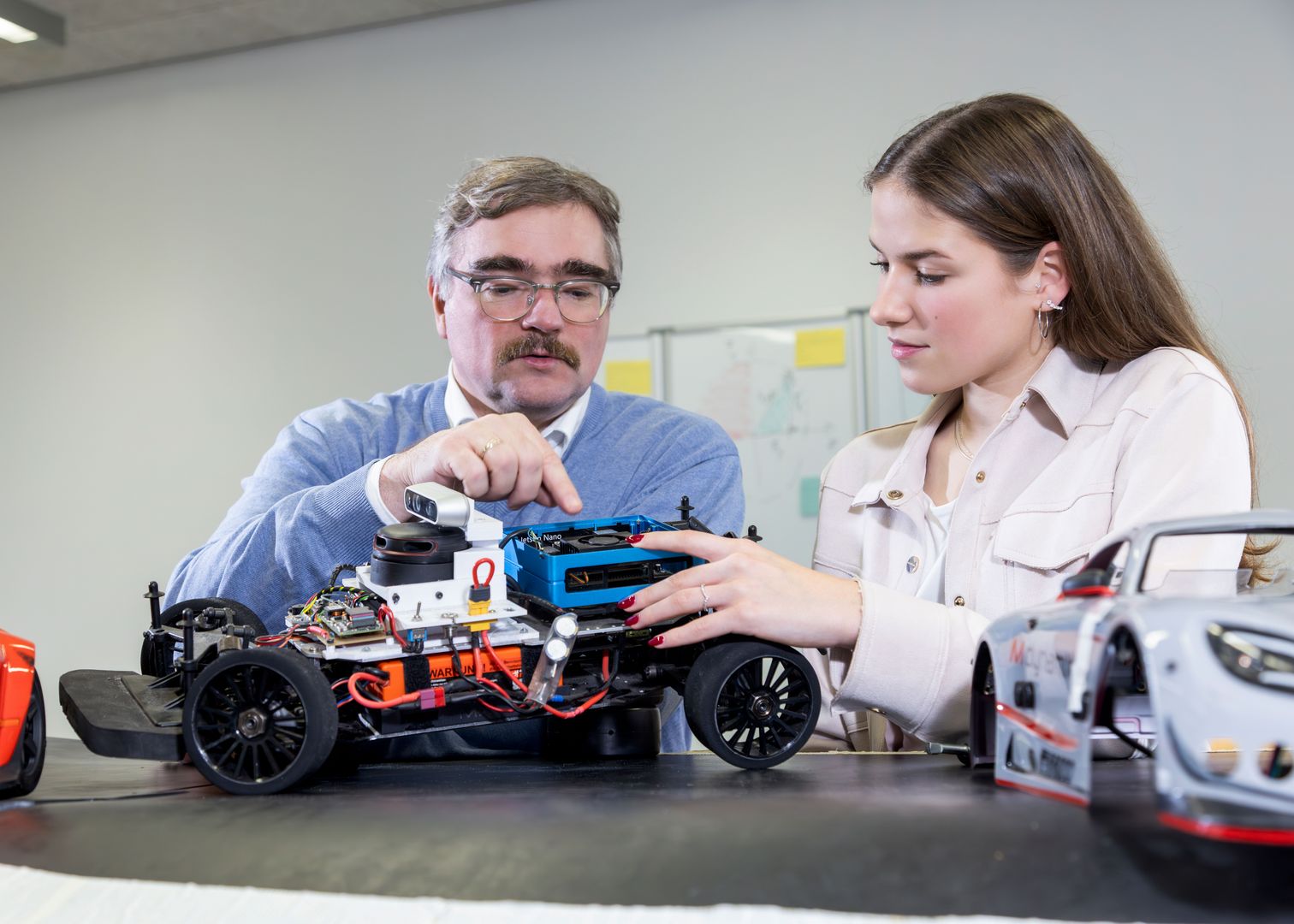
How can intelligent machines be designed, developed, and optimized? Engineers with a bachelor’s degree deepen their knowledge in this area through the new English-language master's degree programme in Mechatronics at Bochum University of Applied Sciences. The degree programme is currently undergoing accreditation and is scheduled to launch on the Velbert/Heiligenhaus campus in the winter semester/fall semester of 2026/27. “Through English-language instruction, students are specifically prepared for leadership roles in internationally active companies,” says Dr. Markus Lemmen, Professor of Control and Vehicle Systems Engineering, offering insights into the degree programme.
What potential does Mechatronics hold for the future?
Prof. Dr. Markus Lemmen: Mechatronics combines the disciplines of Mechanical Engineering, Electrical Engineering, and Computer Science and is an often-underestimated field. Yet it is precisely the integration of these three disciplines that is needed to develop modern, intelligent machines such as robots, electric cars, or smart production facilities. In Mechatronics, the first step is to consider what new functions you want a product to have, and then, in the next step, to focus on how these new functions can be developed. In mechatronics, our starting point is always the benefit and functionality. We have an end product in mind in some form and look at what can additionally be achieved using mechatronic tools. The holistic mechatronic approach that students deepen during their master’s program thus starts with the solution, not the tools. There are very few products in Germany that do not incorporate mechatronic concepts and are still competitive. Modern, internationally competitive products and manufacturing techniques require all three disciplines, and Mechatronics unifies them together. In this respect, Mechatronics is very future-oriented.
Why was the new Mechatronics master's degree programme designed?
Prof. Dr. Markus Lemmen: With this degree programme, we are already addressing today an industry need that will become apparent in a few years. Then, a wave of retirements among engineers of the baby boomer generation will hit the industry, accompanied by a high demand for new skilled workers. Local talent is unlikely to be able to meet this demand on its own. The new English-language master's degree programme in Mechatronics complements our German-language degree programmes. It offers international Bachelor’s degree holders in engineering the opportunity to deepen their knowledge over four semesters and gain a foothold in the local job market. Over the course of two semesters, international students will acquire German language skills alongside their technical knowledge, thereby facilitating their integration into society and the job market. Likewise, with this new range of courses, we are giving our German students the opportunity to prove themselves on an international level. In a subject-specific context, the Master’s in Mechatronics also allows them to expand their English language skills, which, for example, makes it easier for them to communicate in international teams.
What are the main areas of focus in the Master’s program?
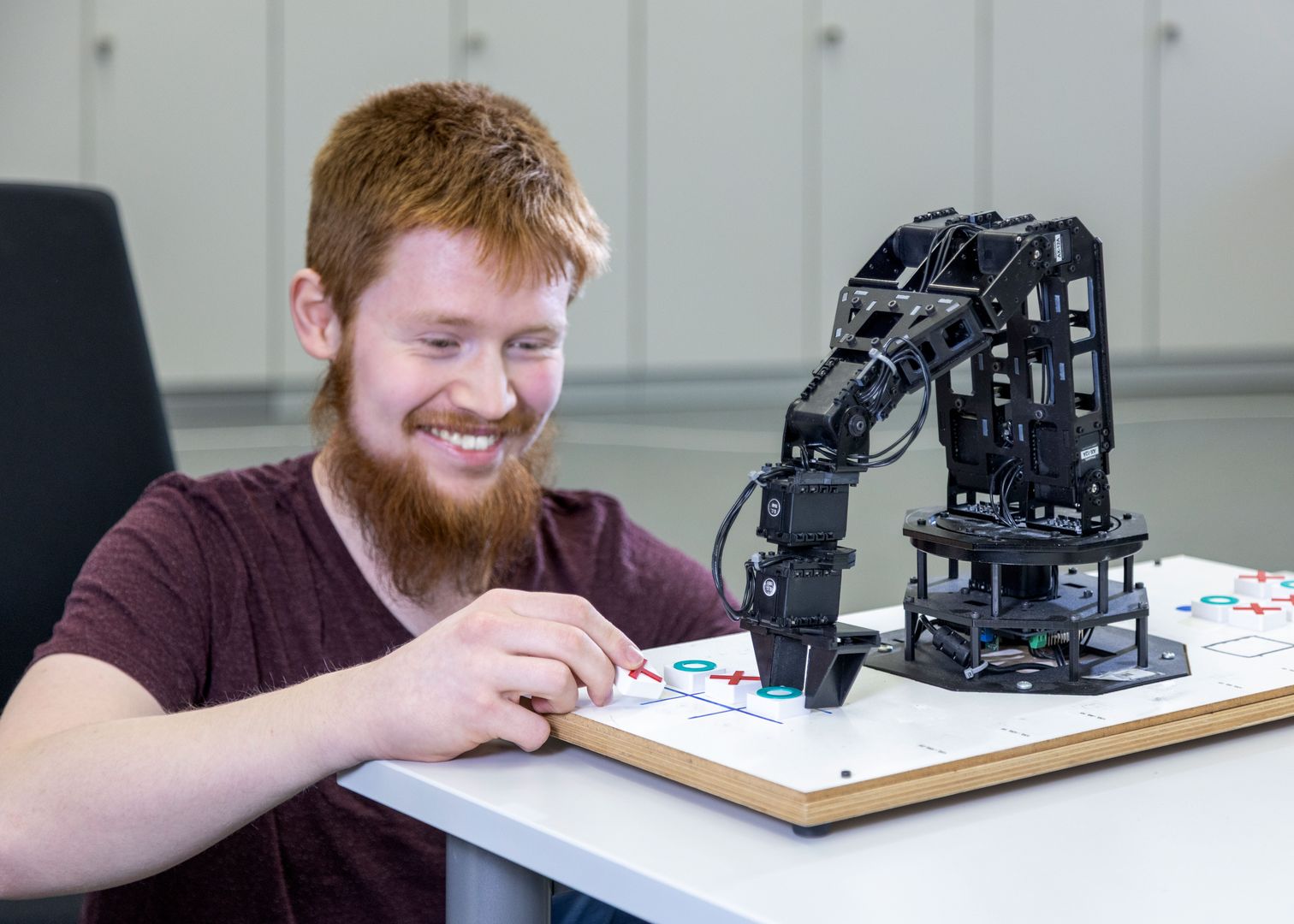
Prof. Dr. Markus Lemmen: The Master’s program focuses on autonomous robotics and automated driving. Both are future technologies crucial for the industry’s competitiveness. Students learn engineering tools to plan, develop, and refine autonomous robots and automated functions in vehicles. In the field of automated driving, this can involve driver assistance systems; in robotics, students also work with service robots used in Nursing to transport medical supplies from point A to point B, or industrial robots deployed in manufacturing facilities to further increase production efficiency.
Regarding both focuses: What do students learn in the modules?
Prof. Dr. Markus Lemmen: Students learn about autonomous, mobile systems and robots that move and act independently in their environment. The basis for this is the sensors these systems and robots need to determine their position, orient themselves in the environment, detect obstacles, or perform tasks in areas such as logistics or production. Students acquire expertise in various sensor, localization, and navigation technologies in robotics and automated driving. They learn to distinguish, for example, which sensors a humanoid robot needs versus an autonomous transport vehicle, and how systems such as robots or vehicles can recognize their respective environments even more reliably through sensor data fusion—that is, by combining data from multiple sensors. In this context, students also deepen their knowledge of control engineering, which controls the sensors and actuators in autonomous robots and autonomous vehicles. Control engineering processes the sensor data and sends signals to the actuators, which ultimately execute actions, such as starting the engine or grasping a component. Thus, it is not simply a matter of controlling an arm that is supposed to move; individual actuators within it must always be controlled to set something in motion. Students will also explore various electric drives. A large motor might be installed in a robot’s shoulder, but a robot’s finger joint doesn’t have to handle the same load. Hence, a smaller and lighter motor may be used here. Students learn to select suitable motors for the development of electric drive systems, explore methods of digital image processing and artificial intelligence, and gain comprehensive insights into how software for Mechatronics systems can be developed; therefore, they also engage with programming. In terms of course content, we specifically aim to align the academic level, as we expect a diverse student body; after all, not all degree programmes worldwide cover the exact same content.
How practical is the master’s program?
Prof. Dr. Markus Lemmen: In all modules, the course content is taught in a practical manner; in our lab facilities, we discuss real-world problems and work closely with hardware. Students will develop and implement functions for an autonomous vehicle themselves, and build, program, and optimize systems such as robots here. We have various robots at our campus that are integrated into teaching, including industrial robots that operate in isolation as well as cobots—collaborative robots that can interact with humans and work alongside them in a workplace. In addition, we have a small fleet of autonomous vehicles that can be used by small groups of students to develop new automated functions. A central component of the program is a one-year lab internship in the second and third semesters.
What kinds of problems do students work on during the lab internship?
Prof. Dr. Markus Lemmen: There are many and they are very diverse, for example: How can collaborative robotic arms be mounted on a mobile platform and powered? And what software, navigation, and safety components are needed to turn this into a fully operational mobile service robot? Or, with regard to image processing: How can a specific part be identified by a camera system and precisely picked out by a robot from an overturned box full of components—in other words, a colorful, chaotic pile? This involves aspects such as component recognition and localization. Another research question might address localization through the use of landmarks, which is employed in robotics and autonomous navigation to determine one’s own position. For example, a street pole or a road sign serves as a landmark for a vehicle to navigate a route. But what if people suddenly stand along the route and the landmark intended to provide orientation is obscured? The same curve suddenly looks different to the vehicle. Students also explore, for example, the effects of highly dynamic environments on autonomous systems.
What should prospective students bring to the program?
Prof. Dr. Markus Lemmen: The master’s program is aimed at prospective students who have successfully completed a bachelor’s degree in engineering and possess a basic understanding of mathematics. In the field of Mechatronics, alumni work on a constant stream of new projects; and whether they’re pursuing the development of new products or the automation of processes, what prospective students should definitely bring to the table is creative thinking. In Mechatronics, it’s always about finding solutions for new tasks and functions, and developing these solutions requires creativity. Beyond that, I find curiosity and a thirst for knowledge—the desire to deepen existing knowledge—to be very important. Because if I, as a student, am convinced of the value of the program, it is precisely this conviction that provides the necessary motivation for studying.
How is the program structured?
Prof. Dr. Markus Lemmen: We have deliberately structured the program so that there are no classes on one to two weekdays per week. In some cases, hybrid classes are also offered. This flexibility allows students, for example, to already pursue a career while completing their master’s degree.
What are the career prospects for alumni? In which fields can they work after completing the master’s program?
Prof. Dr. Markus Lemmen: Alumni can work both nationally and internationally, for example in the automotive and electrical industries, in mechanical and plant engineering, or in automation technology. Other sectors with excellent career prospects include medical technology, energy supply, aerospace, and robotics. There, they work as development engineers or systems developers, but can also pursue careers in quality management, process optimization, project management, or project leadership. The degree programme also prepares students for careers in research institutes. In a world where digitalization and automation are on the rise, there is a growing need for specialists who not only understand machines but can also program the electronic controls and software for these machines. Therefore, Mechatronics offers excellent long-term career prospects.
Mechatronics Degree Program
Information on the Degree Program


